Best Cafes in Vienna
Vienna doesn’t do coffee the way other cities do. Here, coffee is an excuse to sit still. You order one small cup, and nobody expects you to leave. The waiter brings it on a silver tray with a glass of water, and the chair you’re sitting in might be the same one where someone argued about art or politics a hundred years ago. That’s the whole point.
I’ve spent a lot of time wandering between Vienna’s grand coffee houses and its smaller, quieter corners, and the thing that keeps pulling me back is how different each place feels. Some are all marble and chandeliers. Others are cramped rooms with mismatched chairs and the smell of fresh strudel drifting out of the kitchen. Both are worth your time.
This guide covers the ten cafes I’d actually send a friend to, what to order at each, and what you’ll pay.
What Makes Vienna’s Food Scene Special
Vienna’s coffee house culture is so specific that UNESCO put it on its Intangible Cultural Heritage list back in 2011. That tells you something. These aren’t just places that sell coffee. They’re living rooms for the whole city, and they’ve worked that way since the 1600s, when the first coffee houses opened after the Ottoman siege left sacks of coffee beans behind.
The rules are different here, too. A “Melange” is the classic order — half coffee, half steamed milk, topped with foam — and it tastes nothing like a flat white. Then there’s the Einspänner, black coffee under a thick cap of whipped cream, served in a glass. And the Fiaker, which adds a splash of rum. Every cafe has its own menu of these, and regulars have strong opinions about which version is right.
What makes the scene special is the range. You can sit under the vaulted ceilings of Café Central, where Trotsky once played chess, and then twenty minutes later be squeezed into Café Hawelka, where the furniture looks like it survived a war and the Buchteln — little jam-filled buns — come out of the oven late at night. Vienna lets both of those things be true at once. Add the cake culture — Sachertorte, Esterházy torte, apple strudel — and you’ve got a food scene that’s really about slowing down. For a similar slow-food spirit, see our Best Restaurants in Paris guide. If you’re planning a bigger food trip, the slow-food spirit here is a lot like the one in Paris.
How We Picked These Spots
I picked these ten cafes using a few simple tests. First, the coffee has to be good — not just famous. Second, the place has to feel like Vienna, not like a theme park version of it. Third, it has to be somewhere I’d happily sit for an hour with a book or a friend. A couple of these are genuinely world-famous and busy because of it. The rest are local favourites that most visitors walk straight past.
I also mixed the grand and the small. The big historic coffee houses are part of the experience, and skipping them would be silly. But the little ones — the ones with six tables and a grumpy waiter who secretly loves his job — are where Vienna actually lives. Prices here are what I saw on recent visits; they drift up a bit every year, so treat them as a guide rather than a promise.

Café Central
Café Central is the one everyone photographs, and honestly, it earns the attention. The vaulted ceiling, the marble columns, the pianist playing in the corner — it’s the full nineteenth-century coffee house, preserved in the Palais Ferstel on Herrengasse. This was the living room of Vienna’s writers and thinkers around 1900, and you can feel that history the second you walk in.
Order the Wiener Melange and a slice of Sachertorte, or the Central’s own take on it. The coffee is smooth and well made, the cake is rich without being heavy, and the service is formal in the old Viennese way — the waiters wear dinner jackets and they know their job. It costs more than a neighbourhood cafe, roughly €6 for a Melange and €7 or so for cake, but you’re paying for the room as much as the food. Go early or late to dodge the midday queue.
Café Sacher
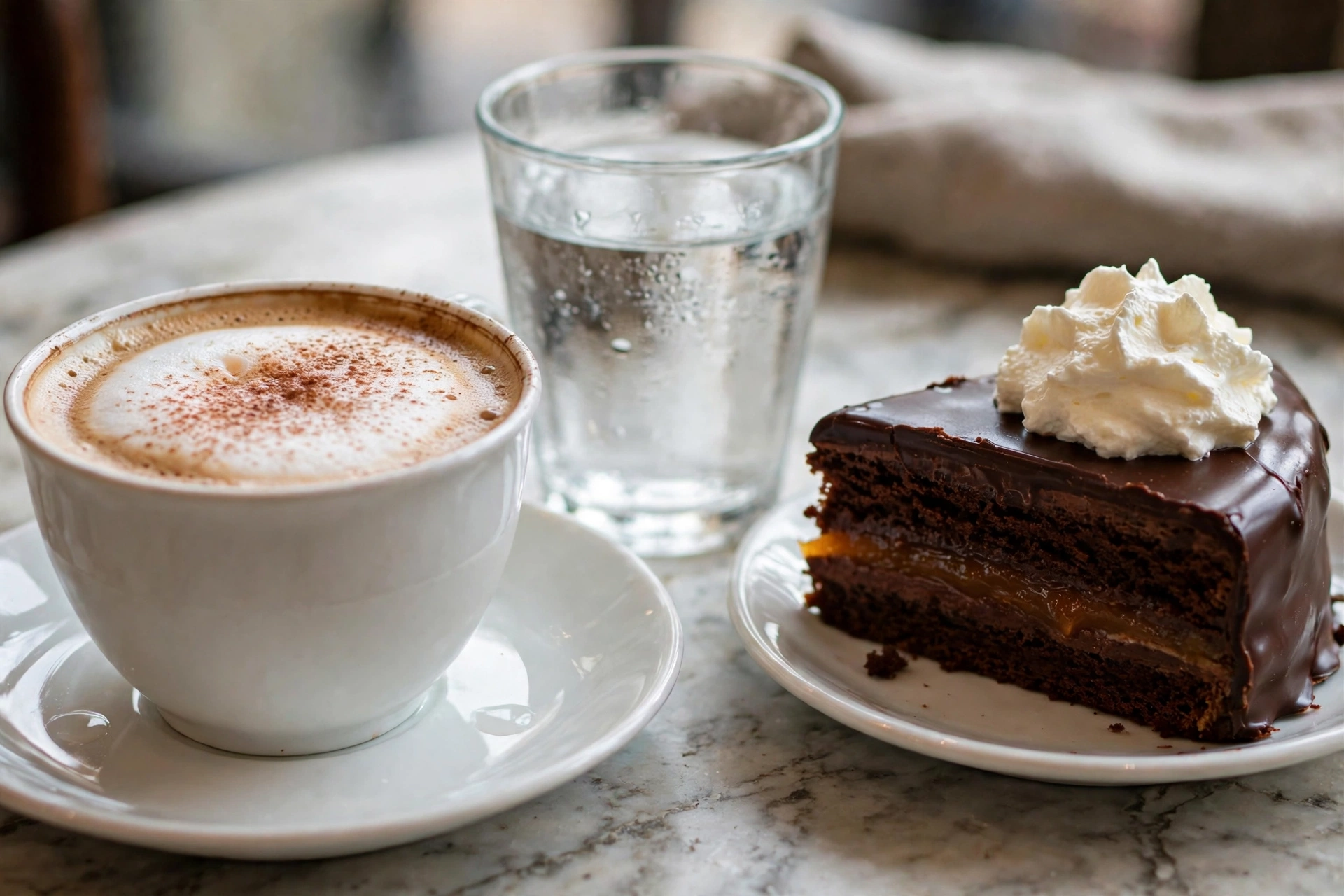
Café Sacher exists because of one cake. The Sachertorte — dark chocolate sponge, a thin layer of apricot jam, and a glossy chocolate glaze — was invented here in 1832 by Franz Sacher, and the hotel still guards the “original” recipe like a state secret. The cafe itself is plush and red and quietly elegant, tucked inside the Hotel Sacher opposite the opera house.
The torte is the move, obviously, served with a cloud of unsweetened whipped cream. Some people find it a touch dry on its own; the cream fixes that. A slice runs about €8, and a Melange to go with it is another €6 or so. It gets busy, especially after opera performances, but the line moves faster than you’d think. If the main cafe is packed, the smaller Sacher Eck across the street serves the same cake with less of a wait. Either way, this is the one cake in Vienna you really should try at its source.
Demel
Demel is less a cafe and more a working piece of history. Founded in 1786, it was the official supplier to the imperial court, and the shop on Kohlmarkt still makes its cakes and pastries by hand in front of you — there’s a viewing window where you can watch the pastry chefs at work. The building is all pale wood and glass, and it smells like sugar and butter.
The thing to get here is the Demel Sachertorte, which is their version of the famous cake (and the subject of a decades-long legal fight with the Sacher hotel over who owns the name). It’s a little lighter than the Sacher’s, in my opinion, and very good. Or try the Esterházy torte, or a slice of apple strudel with vanilla sauce. Prices are on the high side — cake around €6–7, coffee €5–6 — but the quality is real.
Café Hawelka
Café Hawelka is the opposite of grand. It’s a small, dark, slightly shabby room on Dorotheergasse, with old furniture, faded posters, and a history of artists arguing in the corners. Leopold Hawelka opened it in 1939, and it became the late-night hangout for Vienna’s painters and writers. It still feels like that — no fuss, no polish, just a room that happens to serve wonderful coffee.
The star here is the Buchteln, small yeasted buns filled with plum jam, baked fresh and served warm, usually in the evening. They sell out, so go after 8pm and ask if they’re ready. A Melange here costs around €4.50, and the whole experience is cheaper and more relaxed than the big names. If you only visit one cafe that isn’t on a postcard, make it this one.
Café Landtmann
Café Landtmann has been open since 1873, and it sits right on the Ringstrasse near the Burgtheater, which means it has always been the cafe of actors, politicians, and journalists. Sigmund Freud was a regular, and the story goes that he kept a table here. The interior is elegant without being stuffy — dark wood, brass, and big windows looking out at the boulevard.
The coffee is solid and consistent, and the breakfast is worth getting up for: fresh bread rolls, soft-boiled eggs, good butter, and strong coffee for around €12–15. The cake counter is generous, too — try the Landtmann torte if it’s on offer. It’s a popular spot, but the room is big enough that you can usually find a table without much waiting.
Café Museum
Café Museum sits near the MuseumsQuartier, and it’s been the artists’ cafe since 1899, when it was designed by Adolf Loos with deliberately plain interiors — no chandeliers, no fuss, just bentwood chairs and a clear, calm room. The Secession artists drank here, and the modern crowd that fills it now isn’t so different: students, designers, and museum-goers.
The coffee menu is excellent and the kitchen is better than most cafes — proper breakfasts, soups, and simple Austrian dishes at fair prices. A Melange runs about €4.50, and lunch dishes sit around €10–14. The terrace is one of the nicest places to sit on a warm day, right on Karlsplatz with the Secession building across the way.
Café Prückel
Café Prückel, on the corner of Stubenring near the Museum of Applied Arts, has been serving since 1903, and its interior is a beautiful piece of 1950s design — curved booths, warm wood, and a long counter that feels like a film set. It’s a proper old-school cafe, and it has kept its character while the city around it changed.
This is a great breakfast spot. The rolls are fresh, the eggs are cooked properly, and the coffee comes with the usual glass of water and a newspaper on a wooden stick, the old Viennese way. Prices are gentle — a Melange around €4.50, breakfast from €8. The vibe is local and unhurried; you won’t find tour groups here.

Café Jelinek
Café Jelinek is the kind of place you stumble into by accident and then tell everyone about. It’s in a quiet residential street near the Naschmarkt, and it has barely changed since the 1980s: old wooden tables, a slightly crooked counter, and a loyal crowd of regulars who treat the place like an extension of their living rooms. There’s no website hype here, just good coffee and a calm room.
Everything is homemade, from the cakes to the little sandwiches, and the prices are refreshingly low for Vienna — coffee around €3.50–4, cake under €5. The apple strudel is the thing to order, warm from the oven with a little cream. If you want to know what a real Viennese neighbourhood cafe feels like, come here.
Café Sperl
Café Sperl, open since 1880, is on Gumpendorfer Strasse, and it’s one of the most elegant of the old coffee houses. The interior is all polished wood, brass fittings, and a billiard room in the back — yes, you can still play. It was a favourite of musicians and writers, and it has a hushed, civilised atmosphere that makes you lower your voice when you walk in.
The Sperl torte is the house special, and it’s worth ordering, along with a Melange or an Einspänner. Coffee costs about €5, cake around €6. It’s a beautiful place for a long, slow afternoon, especially on a rainy day when the light through the windows turns golden.
Café Frauenhuber
Café Frauenhuber claims to be Vienna’s oldest cafe, dating back to 1824, and it has a lovely claim to fame: Mozart and Beethoven both played here when it was a concert venue. The room is small and warm, with marble tables and a painted ceiling, and it feels more like a parlour than a cafe.
The coffee is good, the cakes are classic — try the Esterházy torte — and the prices are fair, roughly €4.50 for a Melange and €5–6 for cake. It’s right in the old town, a few steps from St. Stephen’s Cathedral, so it’s easy to reach, but it never gets the crowds that the bigger names draw. For a different kind of food trip, our Best Restaurants in Dubai guide is worth a look, and if you’re heading east, Best Ramen in Tokyo is the contrast — fast, hot, and standing-room only.
Eating on a Budget
Vienna’s grand cafes aren’t cheap, but you don’t have to spend a fortune to enjoy them. The trick is to treat the big names as a one-time experience and do your everyday coffee drinking in neighbourhood spots like Jelinek or Hawelka, where a Melange and a slice of cake come to under €9. Breakfast in a cafe is often the best deal in the city: rolls, eggs, coffee and juice for €10–12 will keep you going until dinner.
Supermarkets like Billa and Spar sell excellent bread, cheese, and cold cuts if you want to build a cheap lunch, and the Naschmarkt has stalls where you can eat well for under €10. And if you’re watching your budget, skip the cakes at the famous spots and order them at smaller cafes instead — the quality is often just as good for half the price.
Tips for First-Time Visitors
First, don’t rush. Viennese cafe culture is built around staying put, and waiters expect you to linger. Order one coffee, read the newspaper, and nobody will hurry you along. Second, learn the basic orders: Melange, Einspänner, Verlängerter (a longer black coffee), and kleiner Brauner (a small black coffee with a dash of milk). Knowing those four covers most situations.
Third, tipping is simple — round up, or add about 5–10 percent. Say “danke” when you hand over the money and keep the change you want. Fourth, most cafes open around 7 or 8 in the morning and stay open until 10 or 11 at night, so they’re useful all day. And finally, if there’s a queue outside a famous cafe, check whether the wait is really worth it — often the cafe two streets away is just as good.
Frequently Asked Questions
What is the most famous cafe in Vienna?
Café Central is the most famous, thanks to its grand interior and its history as the meeting place of writers like Peter Altenberg and Leon Trotsky. Café Sacher is a close second, famous for the original Sachertorte. Both are worth a visit, but go early to avoid the queues.
What should I order at a Viennese cafe?
Start with a Wiener Melange — half coffee, half steamed milk — and a slice of cake. Sachertorte, Esterházy torte, and apple strudel are the classics. If you want something stronger, try an Einspänner, which is black coffee topped with whipped cream.
How much does coffee cost in Vienna?
A Melange usually costs €4–6, depending on the cafe. Grand historic cafes charge more, around €6, while neighbourhood spots are closer to €3.50–4.50. Cake adds another €5–8. A coffee and cake together typically come to €9–14.
Do I need to tip in Viennese cafes?
Tipping is customary but modest. Round up to the nearest euro, or add about 5–10 percent for good service. Hand the tip directly to the waiter when you pay, rather than leaving it on the table.
Can I sit for a long time with just one coffee?
Yes — that’s the whole point of Viennese cafe culture. It’s completely normal to sit for an hour or two over a single coffee, reading or working. The waiters won’t rush you, and in the old coffee houses, newspapers and magazines are provided free for guests.
Conclusion
Vienna’s cafes are the best reason to slow down in a city that rewards it. Start with the grand rooms — Central, Sacher, Demel — because they really are as beautiful as everyone says. Then go find the small ones, the Hawelkas and Jelineks, where the coffee costs less and the regulars know the waiter’s name. That’s where Vienna stops being a postcard and starts feeling like a place you could live in. Order a Melange, ask for a slice of whatever cake looks best in the case, and stay a while. Nobody will mind. In fact, that’s exactly what you’re supposed to do.