
World Famous Food Dishes Everyone Should Try Once
Some dishes stay local secrets. Others travel so far, and are loved so completely, that they become part of how the whole world eats. This guide to world famous food dishes is a celebration of those plates — the ones travellers plan trips around, home cooks attempt on Sundays, and entire cities proudly claim as their own.
A quick honesty note before we start: almost every dish below has a debated origin story, a dozen regional versions, and a fiercely loyal hometown. We have stuck to what is well established, flagged the legends as legends, and focused on the versions that made each dish famous in the first place.

How We Picked These Dishes
Every dish on this list had to earn its place the slow way — through decades (sometimes centuries) of people actually eating it, loving it, and carrying it across borders. Fame that comes from one viral moment did not count; fame that survives generations did.
- Genuinely global reach — the dish is eaten and recognised far beyond its home country.
- A clear home and story — each dish is tied to a place, a tradition, or a kitchen that made it famous.
- Still made the traditional way somewhere — you can still travel and taste a respected, classic version.
- Loved by ordinary diners, not just critics — these are dishes people queue for, crave, and cook at home.
If you enjoy lists like this, our wider collection of famous dishes from around the world is a good place to keep exploring after this one.
The Dishes the World Can’t Stop Eating
Sushi — Japan
At its best, sushi is a study in restraint: warm, lightly seasoned rice shaped by hand, topped with fish cut with near-surgical care, and eaten within seconds of being made. The Edomae style of Tokyo — named after the old word for Tokyo Bay — set the template the world now follows, built on cured, marinated, or impeccably fresh fish served as nigiri at a quiet counter. The honest caveat is that great sushi is deceptively hard to copy; the rice, the knife work, and the timing take years to learn, which is why a master-led counter meal feels so different from a supermarket tray.
Best for: Purists who believe the simplest food is the hardest to perfect.
Pizza Napoletana — Naples, Italy
Naples gave the world its most imitated flatbread: a soft, puffy-edged pizza baked fiercely fast in a wood-fired oven until the crust blisters and freckles with char. The centre stays almost soupy, the cornicione — the raised rim — stays pillowy, and toppings stay few: tomato, mozzarella, basil, olive oil. The famous Margherita story, involving a pizza made for Queen Margherita in the colours of the Italian flag, is best treated as a beloved legend rather than settled fact. What is certain is that Naples formalised its pizza-making tradition so seriously that the art of the Neapolitan pizzaiuolo has received UNESCO cultural heritage recognition.
Best for: Anyone who wants to understand why less topping is more.
Croissant — Paris, France
The croissant is Paris in pastry form — shattering, golden layers wrapped around a soft, buttery centre — but its roots honestly reach back to Vienna’s crescent-shaped kipfel, which is why the French still call this family of pastries viennoiserie. French bakers took the idea and ran with it, perfecting the lamination: dough and butter folded and rolled again and again until the layers separate in the oven into that honeycombed interior. The caveat for travellers is that quality varies wildly even in Paris; look for a proper bakery making its own, where the layers crackle audibly when you squeeze the pastry gently.
Best for: Breakfast people, and anyone who judges a city by its bakeries.
Peking Duck — Beijing, China
Peking duck is theatre as much as dinner: a duck roasted until its skin turns deep amber and glass-crisp, carved tableside with ceremony, then eaten tucked into thin pancakes with spring onion, cucumber, and sweet bean or hoisin-style sauce. Beijing’s Quanjude is the name most associated with the dish, a long-standing restaurant famous for its roast duck tradition and for serving it to generations of locals, travellers, and visiting dignitaries. The defining pleasure is contrast — crackling skin, tender meat, cool vegetables, soft pancake. The honest caveat: the full traditional experience takes time and is really a shared, sit-down occasion, not a quick bite.
Best for: A celebratory group dinner built around one magnificent centrepiece.
Tacos al Pastor — Mexico City, Mexico
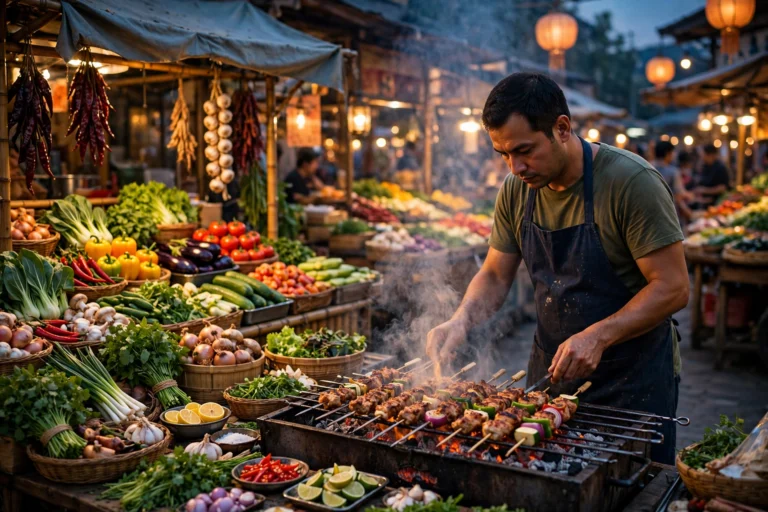
Tacos al pastor are Mexico City’s beloved street taco: marinated pork shaved from a vertical spit — the trompo — crisped at the edges, and served on small corn tortillas with onion, coriander, salsa, and a sweet shard of pineapple from the top of the spit. The technique carries an honest, well-documented debt to Lebanese immigrants who brought shawarma-style cooking to Mexico, which Mexican cooks then made entirely their own with pork, chillies, and achiote. Eaten standing at a busy taquería, two or three at a time, they are fast food at its most joyful — and famously inexpensive compared with almost everything else on this list.
Best for: Street-food lovers and late-night eaters.
Pad Thai — Thailand
Pad Thai is Thailand’s most exported noodle dish: rice noodles wok-tossed with tamarind for gentle sourness, egg, bean sprouts, chives, crushed peanuts, and prawns or chicken, finished at the table with lime, chilli, and a little sugar so each eater balances it personally. It is widely reported to have been promoted as a national dish in the mid-twentieth century, and whatever the politics of its rise, its flavour logic — sweet, sour, salty, and smoky from a ripping-hot wok — is purely Thai street cooking. The caveat is sweetness: versions made for tourists abroad often skew sugary, while the best street stalls keep the tamarind tang firmly in charge.
Best for: First-time explorers of Thai food who want the full flavour balance in one plate.
Biryani — Hyderabad, India
Hyderabadi biryani is a celebration dish built by layering: long-grain basmati rice, marinated meat, fried onions, saffron-tinted grains, mint, and warm whole spices, sealed and slow-cooked — the famous dum method — so the layers steam together into something greater than their parts. Hyderabad is the city most synonymous with it, and its version is known for a bolder chilli heat than northern styles. Served with raita and mirchi ka salan chilli curry, it is food for weddings, festivals, and Fridays. Honest caveat: biryani inspires fierce regional loyalty across South Asia, and Hyderabadi is one great tradition among several — not the only word on the subject.
Best for: Feasts, family gatherings, and anyone who loves rice done properly.
Ramen — Japan
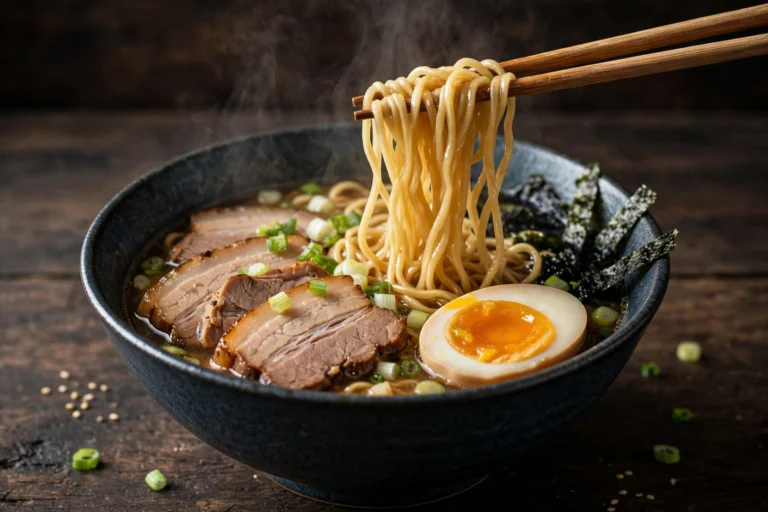
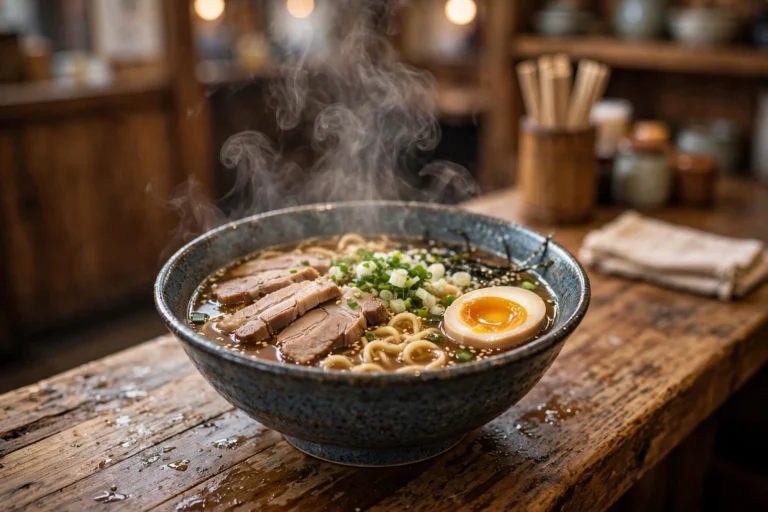
Ramen is Japan’s comfort bowl and its most obsessive: springy noodles in a deeply worked broth, topped with sliced pork, seasoned egg, spring onions, and whatever a region swears by. Part of ramen’s fame is its variety — rich, creamy tonkotsu from Fukuoka, soy-sauce-based shoyu styles, miso ramen associated with Sapporo’s cold winters — each city guarding its version proudly. The dish evolved from Chinese noodle soups brought to Japan, which Japanese cooks transformed over generations into something distinctly their own. The caveat for newcomers: a great bowl is a fast food, eaten noisily while the noodles are perfect; lingering over it is the only mistake you can make.
Best for: Cold evenings, noodle obsessives, and regional food nerds.

Beef Wellington — England
Beef Wellington is British celebration cooking at its most dressed-up: a centre-cut beef fillet coated in mushroom duxelles — and often a layer of pâté or crêpes to protect the pastry — wrapped in puff pastry and baked until the crust is burnished and the meat inside stays rosy. Its name is popularly linked to the Duke of Wellington, though food historians will honestly tell you the connection is more folklore than documented fact. What is not debated is the difficulty: too long in the oven and the beef greys; too little care and the pastry base goes soggy. When a kitchen nails it, few centrepieces feel more festive.
Best for: Sunday roasts, celebrations, and confident home cooks attempting a showpiece.
Cacio e Pepe — Rome, Italy
Rome’s cacio e pepe looks like the easiest dish on this list — pasta, black pepper, Pecorino Romano cheese — and is quietly one of the hardest to get right. The magic is an emulsion: starchy pasta water whisked with finely grated pecorino and toasted pepper until it turns into a glossy sauce that clings to every strand of tonnarelli, the square-cut spaghetti Rome favours. No cream, no butter, no shortcuts — add the cheese off the heat or it clumps, a lesson many home cooks learn exactly once. It belongs to a proud family of Roman classics built from almost nothing, proof that technique can matter more than ingredients.
Best for: Minimalists who want three ingredients to taste like thirty.
Hamburger — United States (with German roots)
The hamburger is the world’s most democratic dish, and its origin is the list’s most honest argument: the name points to Hamburg, Germany, and Hamburg-style beef reached America with German immigrants, while American towns and cooks have competing claims for putting that beef in a bun. What is certain is that the United States turned it into a global language — diner burgers, smashed patties, drive-thru classics, and chef-led versions with dry-aged beef and good buns. The caveat is range: the word covers everything from a sad motorway patty to a great griddled burger, and the difference is care — good beef, a hot surface, and restraint with toppings.
Best for: Everyone, everywhere — that is rather the point of it.
Tom Yum Goong — Thailand
Tom yum goong is Thailand’s hot-and-sour prawn soup, and the first spoonful is an explosion: lemongrass, galangal, and makrut lime leaf perfume the broth, chillies bring real heat, lime juice brings brightness, and river prawns bring sweetness. It comes in two styles — a clear broth, and a creamier version enriched with evaporated milk or coconut milk — and families and restaurants argue over which is correct. Unlike many dishes, it is a soup that eats like a main event, usually shared at the centre of the table with rice. The honest caveat: tom yum is assertively sour and hot, not a gentle starter, so first-timers should brace happily.
Best for: Soup lovers who want brightness, heat, and perfume in every spoonful.

How to Choose What to Eat First
You cannot eat all twelve in a week — well, you could try, and we would applaud you — so choose by the trip you are actually taking. Travelling to one country? Start with its dish in its hometown, where the classic version is protected by pride and habit: pizza in Naples, tacos al pastor at a Mexico City taquería, Peking duck carved in Beijing. Cooking at home instead? Begin with cacio e pepe if you want a technique challenge, biryani if you are feeding a crowd, and pad Thai if you want the best ratio of effort to applause. And if a dish on this list ever disappoints you abroad, hold your verdict until you have tasted it where it was born — geography is an ingredient. For the restaurant-side of famous food, our guide to famous restaurant signature dishes pairs nicely with this one.
Frequently Asked Questions
Which of these dishes is the oldest?
Several have roots stretching back centuries in some form — roast duck in Beijing and layered rice dishes in South Asia both have very long histories — but exact “invention dates” are mostly folklore. What we can say safely is that most of these dishes took their modern, recognisable form in the last two hundred years or so.
Are these dishes expensive to try?
Mostly, no — and that is part of their charm. Tacos al pastor, pad Thai, ramen, and pizza were born as everyday food and remain affordable at home. The exceptions are occasion versions: a full Peking duck service or top-tier sushi counters can run into serious money, because you are paying for mastery and ceremony as much as ingredients.
Can I make these properly at home?
Many of them, yes, with honest expectations. Cacio e pepe, pad Thai, and a good burger are very achievable; croissants and biryani reward patience; sushi and Peking duck are the two where even keen home cooks usually bow to the professionals, because the knife skills and roasting craft take years.
Why do so many origin stories sound disputed?
Because famous food is rarely invented in a single moment by a single person. Dishes evolve as ingredients travel, immigrants adapt techniques, and cities adopt favourites — then everyone argues backwards about who was first. We find the arguments part of the fun, as long as the legends are labelled as legends.
What is the best way to taste an authentic version?
Go where the dish is everyday food, choose busy places full of locals, and order the classic version before the creative ones. A crowded taquería or a Roman trattoria serving three pastas will teach you more about a dish than any ranking — including, we admit, ours.
Final Thoughts
What unites these twelve plates is not luxury or rarity — it is repetition, loved by millions of ordinary meals until a dish becomes a landmark. A taco eaten standing up and a duck carved with ceremony belong on the same list because both tell you, in one bite, where you are in the world.
So treat this list as a travel plan disguised as a menu. Pick the dish that pulls you hardest, go to its home if you possibly can, and taste the version everyone there grew up defending. That is where world famous stops being a label and starts being a meal.

7 Comments